


Buy New or Repair? When Does Repair Really Make Sense?
You know how it is: suddenly a device starts acting up, the battery barely lasts, the charger only works when you hold the cable at a certain angle, or your household appliance makes strange noises and stops working. And then you immediately ask yourself this question: buy a new one or repair it? This “either/or” dilemma is something that many people struggle with, because buying a new one seems like the quickest solution. But if you take a closer look, you'll often realize that the damage isn't total, but rather that a single part is worn out or defective. And that's when it's often worth repairing the item rather than replacing it. Especially if it means you can save a lot of money and avoid electronic waste at the same time. In this article, we'll show you how to make a really sensible decision about “repair or buy new,” how to compare costs realistically, and why it's often smarter to use replacement parts. You'll also get practical tips on how to quickly find the right replacement parts at Electropapa.
Buy new or repair – the most important factors in your decision
When deciding whether a repair makes sense, you should not just rely on your gut feeling, but briefly check a few key points. In practice, the situation often looks like this: the device is basically still in good condition, but a typical wear part no longer works. In this case, repair is often the much better option.
The most important point is usually the question of cost, i.e., the cost of repair vs. buying a new one. If a device costs 300 or 400 euros new, but the repair (or replacement part) only costs 20 to 80 euros, the calculation is pretty clear. Especially if you replace the part yourself.
A second point is the expected additional service life after repair. If you fix a problem and the device then runs reliably for another two or three years, the benefit is huge. A small replacement part can save you a lot of extra time.
Thirdly, the environment plays a role: buying a new device means production, raw materials, transport, and packaging. Repairing old devices makes sense because you conserve resources. And let's be honest: many devices are still technically good enough, and you don't have to throw them away just because one part is broken.
And fourthly, it's about convenience. Buying a new device often seems easier—but that's not always true. Setting up a new device, transferring data, buying new accessories, getting used to the new device: it costs time and nerves. If you replace a part instead, you often have a working device again in no time.
Cost comparison: replacement part vs. new purchase
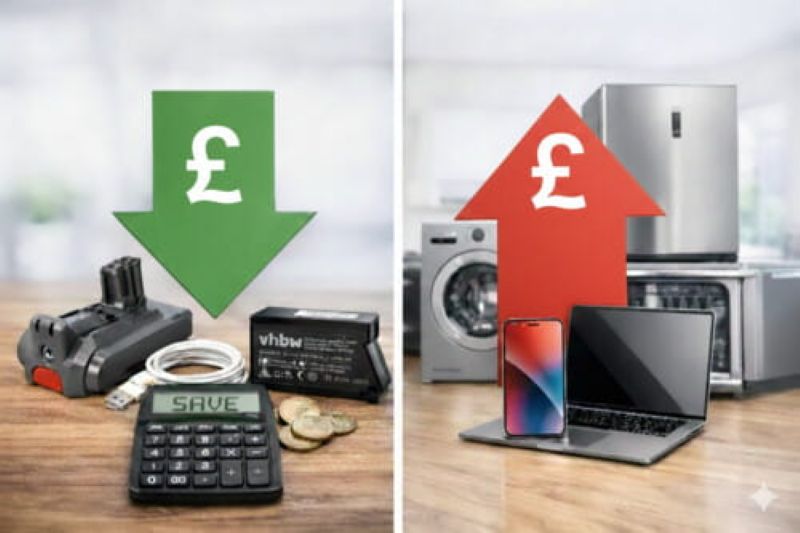
If you make a direct comparison, you'll notice that in many cases, the cost of a replacement part is low compared to the price of a new device.
Take your smartphone or notebook, for example: as soon as the battery starts to deteriorate noticeably, buying a new one often seems like the quickest solution. In reality, the opposite is usually the better option: replacing the battery instead of buying a new device. A high-quality replacement battery from Electropapa costs only a fraction of what a new device would cost.
The same applies to charging problems: often it is not the device that is at fault, but a defective charging cable or power supply. In this case, a suitable replacement charging cable is the quickest and most cost-effective solution.
The cost difference between repair and replacement is often very large for household appliances as well. Precisely because washing machines, dishwashers, and refrigerators are used daily in many households, defects can quickly seem dramatic, but often it is only a single worn part that is at fault. So if you are faced with the decision of whether to repair your washing machine or buy a new one, it is almost always worth checking the cause first and comparing the costs realistically. Many problems can be solved with a targeted replacement, and in these cases, repair is significantly cheaper than buying a completely new appliance. The same applies to household appliances such as dishwashers and refrigerators.
When it makes sense to replace a defective part
Replacement is particularly useful if the fault is clear and isolated. In other words, if you can say with relative certainty: “It's the power supply,” “it's the battery,” “it's the seal,” “it's the switch.” Then it's worth replacing the spare part instead of replacing the entire device.
Typical examples where repair is very often the right choice:
- Battery barely holds a charge → Replace battery
- Device does not charge reliably → Replace power supply or Replace charging cable
- Device won't start → Check power supply, replace power supply
- Household appliance leaks water → Replace seal/hose
- Appliance overheats/is noisy → Clean or replace fan
This is often the better decision, especially if you have a high-quality appliance. The basic quality of your appliance is still excellent—only one component has reached the end of its service life.
Why repairing is often more sustainable and durable
Repairing is not just a cost-saving measure. It is often the smart choice because you are using the resources that are already in the appliance. Many older devices are robustly built and have a long technical lifespan – only individual wear parts give up at some point. If you then use suitable electronic replacement parts, you can significantly extend the life of your device. This is particularly noticeable with batteries: a new battery can make a device suitable for everyday use again without you having to change anything else.
What's more, sustainability isn't just a nice bonus. Electronic waste is a huge issue. Repairing means less waste, fewer new products, and less consumption of raw materials. And you often even get more durability when you install high-quality replacement parts.
Typical defects that can almost always be repaired
Certain faults occur time and time again – regardless of whether you are dealing with a smartphone, a laptop, or a household appliance. The good thing is that because these faults are so common, there are usually suitable solutions available. So if you recognize one of the following cases, there is a very good chance that you won't have to replace your device, but can get it working reliably again with a repair.
Typical examples are:
- Battery is weak or device switches off quickly → Replace battery
- Device does not charge properly / loose connection → Replace power supply
- Display responds slowly or remains black → Replace display/touch unit
- Buttons no longer work reliably → Replace control element or switch
- Household appliance leaks water → Replace seal or hose
- Rattling, humming, or grinding → Replace fan or pump
- Device smells strange / performance deteriorates → Clean or replace filter
In all these situations, repairing is often easier than you might think. The reason: these are usually classic wear parts that are designed for precisely such cases. If you replace the defective part, the problem is often solved immediately—and your appliance is fully operational again.
When is it really worth buying a new one?
There are cases where buying a new one is the more sensible solution, especially if the repair costs are very high or several major defects occur at the same time. In such situations, it may be economically and practically sensible to replace the device with a new one rather than repair it. A new purchase often makes sense if:
- several defects occur at the same time, significantly increasing the total cost
- the device is technically obsolete (e.g., no more updates, limited compatibility, significantly reduced performance)
- important spare parts are no longer available or are only available at disproportionately high prices
How to find the right replacement part
For your repair to be successful, the replacement part must fit your appliance exactly. In practice, many repairs fail not because of the replacement itself, but because the wrong or incompletely compatible part was ordered. That's why it's worth checking the most important data of your device before purchasing and then searching specifically for the right component. At Electropapa, you can buy replacement parts online and rely on a clear product selection. Pay particular attention to:
- Model number / serial number of your device for clear identification
-> The model and serial numbers can usually be found on the type plate on the device, often on the back or underside. For washing machines and dishwashers, it is often located on the inside of the door frame, and for refrigerators, on the inside of the side wall. For smartphones, it can be found in the settings under “Info / About the device.”
- Compatibility information in the product description (e.g., model series, variants, years of manufacture)
This allows you to buy compatible spare parts from Electropapa. This will significantly extend the life of your device, save you money, and avoid unnecessary electronic waste.
Popular replacement parts from the bestsellers
A glance at the bestsellers in our Electropapa online shop quickly reveals which repairs are particularly common. Batteries are among the classic wear parts: over time, their capacity decreases, devices run significantly shorter, switch off unexpectedly, or no longer deliver the usual performance. When the battery is replaced, the difference is often immediately noticeable. That's why battery modules and matching batteries are among the most popular products in the Electropapa range.


The issue of power supply is equally important. Power supplies, chargers and adapters are particularly frequently ordered because charging or start-up problems are often not caused by the device itself. A faulty power supply unit or an unstable power flow is enough to make a device unreliable. With a suitable replacement power supply unit, the problem can often be quickly isolated and permanently solved.


At Electropapa, you will also find many other spare parts and accessories for a wide variety of devices and applications. So if you are looking for a specific part or simply want to be inspired, it is worth visiting our Electropapa online shop and discovering our range.
Repairing is often more worthwhile than you think
When faced with the decision of whether to repair or replace an electrical appliance, a quick cost comparison is usually the best first step. In many cases, the appliance is not a total write-off, but simply has a defect in a single component. If this part is replaced, the repair is often significantly cheaper than buying a new appliance and can noticeably extend the service life of the appliance.
If you want to buy compatible spare parts online, you should pay attention to the exact model assignment so that the respective part really fits. If you value a clear selection and quick product search, you will find suitable components at Electropapa to reliably repair your device and avoid unnecessary expenditure on a new purchase.
Was this post helpful?
Thank you for your feedback!